Departments
 Departments
Departments
Departments

New to Slowsip? Create Account

There is a version of Scotland that exists almost entirely in the imagination — of slate-grey Atlantic light, of Atlantic winds that know no obstacle for a thousand miles, of communities small enough that everyone involved in making something knows everyone else who is. It is, of course, a romanticisation. But standing on the western coast of Harris on a day when the sky cannot decide between rage and beauty, you begin to suspect that some romanticisations are simply accurate.
The Outer Hebrides are not a whisky region in the conventional sense. They appear on no official map of Scottish distilling. There are no heritage trails, no established tourism infrastructure built around the dram. And yet, in the last decade, this remote archipelago has become one of the most closely watched addresses in single malt Scotch — producing bottles that collectors and connoisseurs find themselves returning to, not merely for the liquid, but for what it represents.
The question worth asking is why. And the answer is more interesting than any score on a tasting card.
When a distillery cannot rely on footfall, on easy logistics, on the casual pull of proximity to a major population centre, it must build its identity from something more durable. The Outer Hebrides distilleries have done exactly that. They have made place — the specific, irreducible character of where they are — not a backdrop but a philosophy.
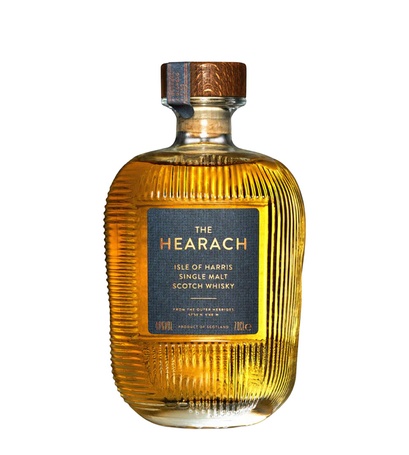
The Isle of Harris Distillery opened in Tarbert in 2015, and from the beginning it was clear that this was not simply a whisky project with a scenic backdrop. The founders were explicit: they were building a social distillery, a business whose purpose was bound up with the economic and cultural life of Harris itself. Distillery workers are recruited from the island. The water comes from An Cliseam, the highest peak in the Outer Hebrides, filtered through ancient Lewisian gneiss — some of the oldest rock on the planet, formed around three billion years ago. The barley is Scottish. The ethos is uncompromising.
All of this would be admirable but ultimately irrelevant if it did not translate into the glass. It does.
The Hearach — named for the Gaelic word for a person from Harris — is a whisky that insists on being met on its own terms. There is salt here, inevitably: the Atlantic is not a subtle presence when the stillhouse windows face directly into the prevailing wind. But there is also a softness that catches first-time drinkers off guard — a sweetness of orchard fruit and vanilla that sits in easy tension with the maritime edge. The spirit is matured primarily in ex-bourbon American oak, with sherry casks playing a supporting role, and the result is a whisky that feels modern in its construction while being entirely rooted in a particular geography.
What the distillery has understood, and what the broader whisky market is only beginning to appreciate, is that provenance is not decoration. When a spirit is shaped by the water that runs through billion-year-old rock, by the salt air that permeates every surface of every building on the production site, by the character and attention of a small community with genuine skin in the game — it tastes different. Not better by some abstract measure, but specifically different. Irreducibly itself.
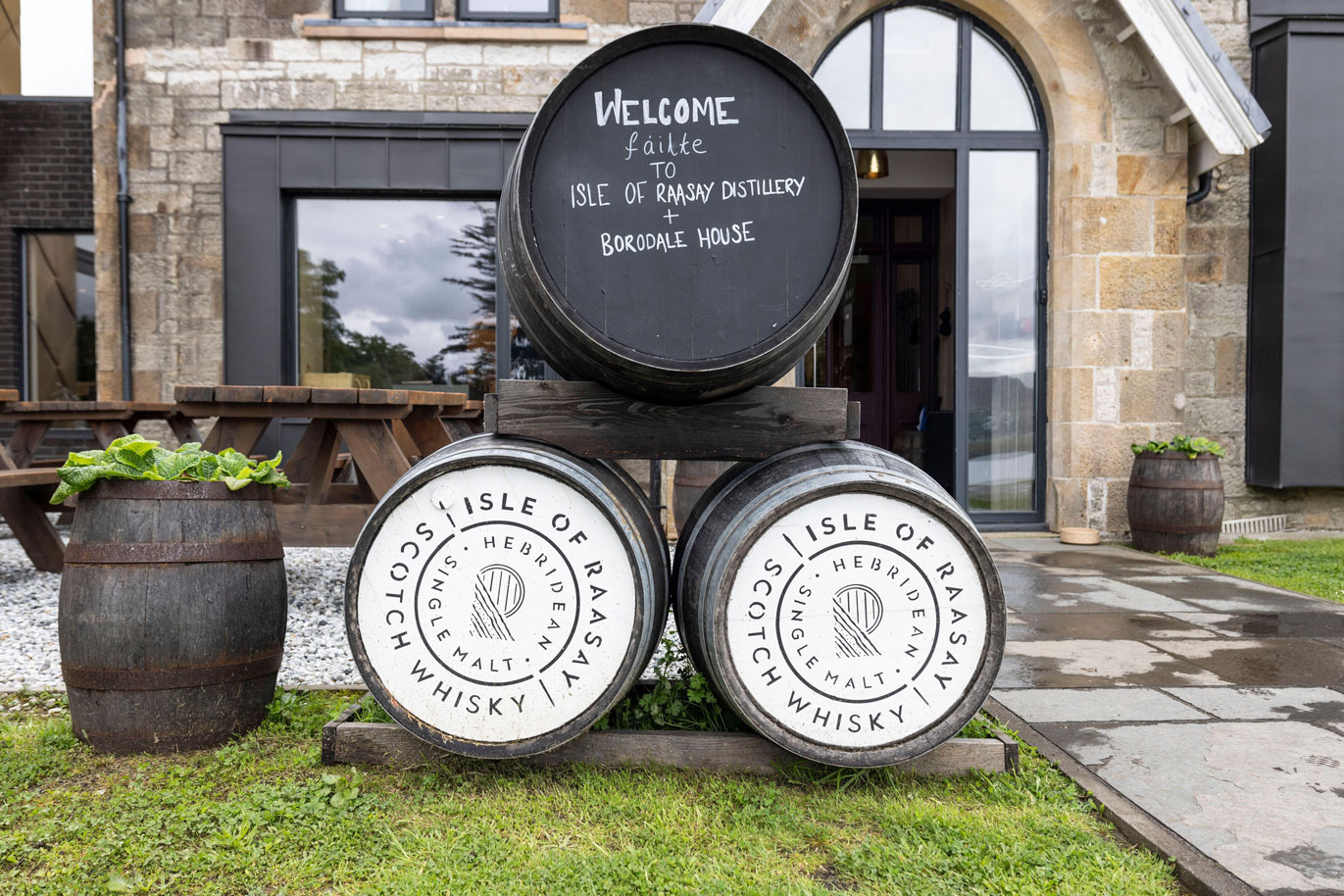
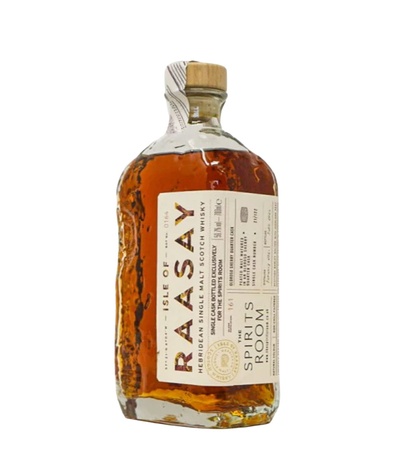
The Isle of Raasay Distillery opened in 2017 on an island with a population of around 160 people — which is to say, it opened on an island where the distillery is now, almost by necessity, a significant part of the community's economic fabric. This is not a boutique operation at arm's length from the world. It is a working distillery on a working island, and the seriousness of that commitment shows in the bottle.
Where Harris leans into maritime softness, Raasay has built its identity around complexity and restraint. The flagship spirit — already drawing serious attention from the trade — is matured in a combination of casks that reflects an almost obsessive interest in what wood can do to whisky: Bordeaux wine barriques, ex-rye whiskey casks from America, heavily charred ex-bourbon barrels. The result is layered in a way that rewards attention over multiple encounters. It is not a whisky that gives everything up on the first meeting.
The Oloroso Quarter Cask expression takes this approach further still. Quarter casks impart flavour at an accelerated rate — the spirit-to-wood contact ratio is dramatically higher in a smaller vessel — and the choice of oloroso sherry wood adds a richness and density that builds through the palate. There is dried fruit here, candied orange peel, something approaching dark chocolate at the finish. The whisky tastes like a longer process than it has been, which is part of the craft: to make something that feels earned without requiring the patience of decades.
What Raasay has demonstrated in a short period of operation is that island provenance need not mean a single flavour profile. The islands have character. That character is expressed differently depending on who is doing the expressing.
The age of the destination distillery is giving way, slowly but unmistakably, to the age of the place distillery. The distinction matters. A destination distillery is a brand that happens to be somewhere. A place distillery is a product of somewhere — inseparable from its geography, its water, its weather, its people, the specific constraints that its location imposes. The Outer Hebrides, for all its apparent impracticality as a production base, has turned those constraints into assets.
This is not a purely Scottish phenomenon. You can trace the same logic through the emergence of serious distilling in the Faroe Islands, in the Scottish Borders, in the remoter corners of Ireland. But the Outer Hebrides has a particular quality — a combination of landscape, cultural identity, and the Atlantic's relentless presence — that lends itself to this kind of story with unusual clarity.

The whiskies being made here are not yet as well known as they deserve to be. The Hearach and the Isle of Raasay expressions remain, for now, the preserve of those who have done some searching — discovered through recommendation, through a well-chosen back bar, through the kind of editorial that takes provenance seriously. That will change. The trade has noticed. The collectors have noticed. The scores, where anyone has bothered to apply them, are serious.
It is not simply that it changes — all light changes. It is that it changes in a way that feels consequential, that makes the landscape look like a different place hour by hour. The islands reward the kind of attention that does not rush, that does not try to extract everything in a single sitting. They ask you to come back.
The whiskies being made here share that quality. They are not expressions designed to be consumed and forgotten. They are bottles that open differently over time — that surprise you on the second pour, or the third, or the one you open six months after the first and find that your memory of the earlier experience has sharpened into something more precise.
That is the real argument for the Outer Hebrides. Not the romance of the landscape, though the landscape is genuinely extraordinary. Not the narrative of community and craft, though both are real and worth respecting. It is simply that the liquid in these bottles is some of the most interesting Scotch whisky being made anywhere in Scotland right now — and that if you have not yet encountered it, the absence is yours to correct.
The Hearach Isle of Harris 70cl and the Isle of Raasay Oloroso Quarter Cask 70cl are available now on SlowSip.